Tips for Getting Rid of Stuff
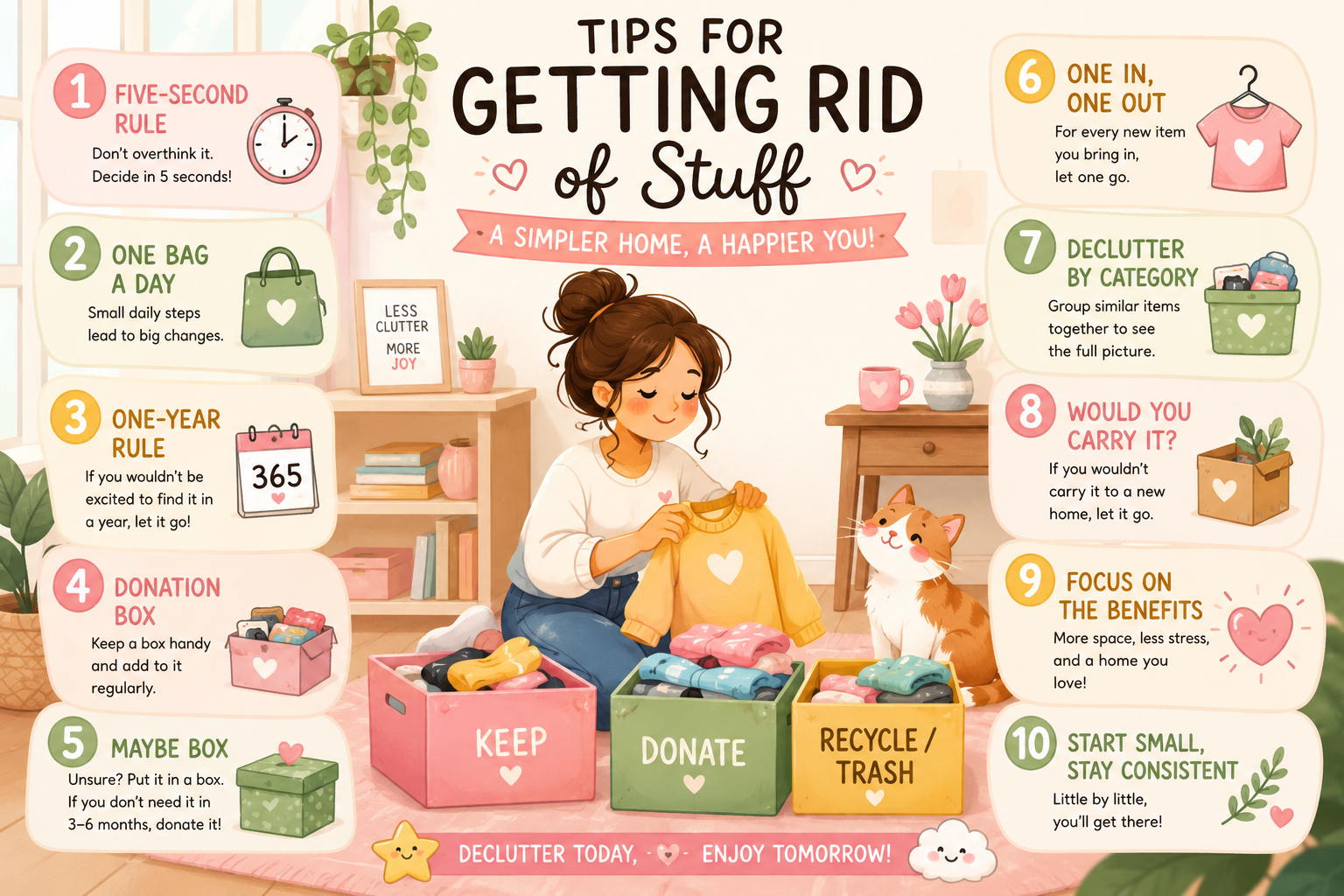
Practical Techniques That Actually Work
Decluttering sounds simple until you're staring at a drawer full of "just in case" items. Whether you're cleaning one room or your entire home, the biggest challenge isn't finding time. It's making decisions.
These modern decluttering techniques combine psychology, habit-building, and practical strategies that have become popular because they help people make real progress without feeling overwhelmed.
1. The "Five-Second Decision" Rule
If an item doesn't require research or sentimental consideration, give yourself only five seconds to decide.
Ask:
Do I use this?
Do I love this?
Would I buy it again today?
If the answer is no, place it in the donation box immediately.
Why it works:
Overthinking creates clutter. Quick decisions reduce decision fatigue.
2. Fill One Bag Every Day
Instead of planning an entire weekend for decluttering, commit to filling just one grocery bag each day.
The bag can contain:
Clothes
Toys
Kitchen gadgets
Old paperwork
Expired products
One bag a day equals over 350 bags removed in a year.
3. Use the "One-Year Test"
Ask yourself:
"If I found this in storage one year from now, would I be excited or relieved to have kept it?"
If your answer is neither, it's probably safe to let it go.
4. The "Outbox Method"
Create a permanent donation box somewhere in your home.
Whenever you notice:
Clothes that don't fit
Toys your kids have outgrown
Duplicate kitchen tools
Books you'll never reread
Place them in the box immediately.
Once the box is full, donate it.
This prevents clutter from building up again.
5. The Reverse Decluttering Challenge
Instead of asking:
"What should I get rid of?"
Ask:
"What would I pack if I were moving tomorrow?"
Everything left behind deserves another look.
This mindset makes priorities much clearer.
6. Take Before and After Photos
Photos provide motivation.
Seeing visible progress:
builds momentum
reduces discouragement
helps you notice improvements your brain quickly gets used to
Many people also keep photos to remind themselves not to let clutter return.
7. The "Maybe Box"
Not ready to let something go?
Place uncertain items into a labeled box.
Write today's date on it.
If you haven't opened the box after three to six months, donate everything inside without reopening it.
This reduces emotional decision-making.
8. Declutter by Category, Not Room
Instead of cleaning one room at a time, gather similar items together.
Examples:
all shoes
all mugs
all towels
all cables
all books
Seeing duplicates often makes it easier to let extras go.
9. The Container Method
Your shelves, closets, and drawers are natural limits.
Instead of buying more storage, decide:
"This drawer only holds socks."
If the drawer is full:
keep your favorites
remove the rest
Storage should define your limits—not expand them.
10. The 20/20 Rule
Popularized in minimalist communities, this rule asks:
If you can replace the item in under 20 minutes and for less than about $20, you probably don't need to keep it "just in case."
It's especially useful for inexpensive household items.
11. Turn Decluttering Into a Game
Set a timer for 15 minutes.
Challenge yourself to find:
10 items to donate
10 pieces of trash
10 things to recycle
Short bursts often feel easier than marathon cleaning sessions.
12. The "Would I Carry This?" Test
Imagine moving into a new home.
Would you willingly carry this item yourself?
If not, ask why you're keeping it.
13. Sell Only Valuable Items
Many people spend months trying to sell low-value items online.
A better rule:
If it's worth less than your personal selling threshold (for example, $20–$50), donate it instead.
Your time has value too.
14. Keep a Donation Bin in Your Car
Once your donation box is full, move it to your vehicle.
The next time you pass a donation center or charity shop, drop it off.
Removing the extra step makes donating much more likely.
15. The "One In, One Out" Habit
Every time something new enters your home:
new shirt
new toy
new kitchen appliance
new decoration
One similar item leaves.
This keeps clutter from quietly returning.
16. Ask the "Future You" Question
Instead of thinking about your past, think about your future.
Ask:
"Will the person I want to become actually use this?"
This shifts the focus from guilt to intentional living.
17. Start With Easy Wins
Begin with items that have little emotional value:
expired food
broken chargers
empty boxes
old receipts
duplicate utensils
worn-out socks
Quick progress builds confidence for harder decisions later.
18. Create Four Sorting Boxes
Label four containers:
Keep
Donate
Sell
Recycle/Trash
Having clear categories speeds up the decluttering process and prevents piles from spreading around the room.
19. Practice the "90/90 Rule"
Ask yourself:
Have I used this in the last 90 days?
Will I realistically use it in the next 90 days?
If both answers are no, it's usually time to let it go.
20. Focus on the Benefits, Not the Loss
Instead of thinking:
"I'm getting rid of my things."
Think:
"I'm creating more space, less stress, and a home that's easier to maintain."
A mindset shift often makes decluttering feel rewarding instead of difficult.
Putting These Tips Into Practice
Getting rid of stuff doesn't have to happen all at once. Small, consistent actions usually lead to bigger and longer-lasting results than occasional deep-cleaning sessions.
Choose one or two techniques that fit your lifestyle, and build them into your routine. Over time, you'll spend less time managing possessions and more time enjoying a home that feels lighter, calmer, and easier to maintain.
Enjoy a Cleaner Home Once the Clutter Is Gone
Getting rid of unnecessary items is one of the easiest ways to make cleaning faster and less stressful. With fewer things collecting dust and taking up space, it's much easier to keep your home looking its best.
Once you've finished decluttering, let the professionals take care of the deep cleaning. Whether you need a thorough refresh, routine house cleaning, or a move-in or move-out cleaning, Kairos Clean & Cozy is here to help you enjoy a cleaner, healthier home.
Ready for a spotless finish? Contact Kairos Clean & Cozy today to schedule your next cleaning service and let us handle the hard work while you enjoy your refreshed space.